0
An empty cart
You have no item in your shopping cart

When specifying timber for a project in Oman, one of the first decisions a site engineer or procurement team faces is the choice between redwood vs whitewood timber. Both species are widely available through Omani timber suppliers, both are used across structural and temporary works applications, and at first glance they can look similar on a merchant’s yard. In practice, their physical properties, durability characteristics, and performance in Oman’s climate differ in ways that matter — especially when concrete formwork cycles, structural loads, or treatment costs are involved. This guide covers what each species actually is, how they compare, and how to specify the right one for your application.
The terms “redwood” and “whitewood” are trade names used throughout the Middle East timber industry, not botanical classifications.
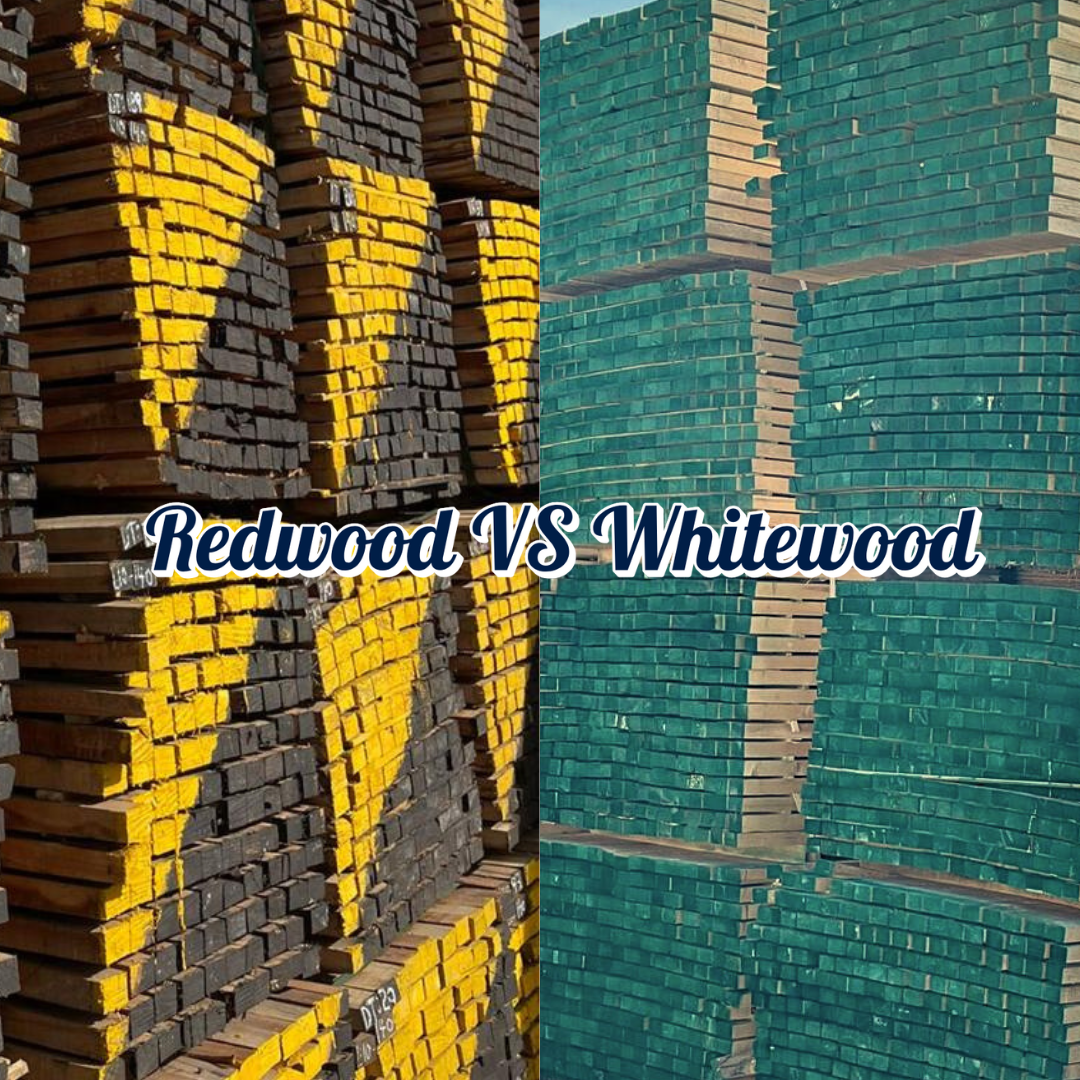
Redwood refers to Pinus sylvestris — Scots pine — sourced predominantly from Romania, Austria, and Russia. It takes its name from the reddish-brown heartwood visible in cross-section. Density typically falls in the range of 510–530 kg/m³ (at 12% moisture content). The grain is generally straight with moderate resin channels, and the heartwood carries natural resin that provides some innate resistance to biological attack.
Whitewood refers to Picea abies — Norway spruce — sourced mainly from Austria, Romania, and increasingly from producers in Malaysia, Vietnam, and China. The pale, almost white sapwood is uniform throughout most of the cross-section, with very little colour differentiation between heartwood and sapwood. Density is marginally lower at around 470–510 kg/m³. The grain is fine and consistent, resin content is low, and the timber takes paint, adhesive, and preservative treatment readily because of its open structure.
In Oman’s construction timber market, the two species are often stocked side by side, and a quantity surveyor or site engineer ordering “construction timber” without specifying species may receive either, depending on what is in stock. Understanding the differences allows you to specify correctly from the outset.
| Property | Redwood (Pinus sylvestris) | Whitewood (Picea abies) |
|---|---|---|
| Density (kg/m³ at 12% MC) | 510–530 | 470–510 |
| Characteristic bending strength (C16) | 16 N/mm² | 16 N/mm² |
| Heartwood colour | Reddish-brown | Cream to pale yellow |
| Resin content | Moderate to high | Low |
| Natural durability class (EN 350) | Class 3–4 (moderately durable) | Class 4 (slightly durable) |
| Treatability | Moderate (heartwood resistant) | Good (absorbs preservative readily) |
| Nail and screw holding | Good | Good to very good |
| Surface finish quality | Resinous; may bleed | Clean; takes paint uniformly |
At equivalent structural grades (C16 or C24 under BS EN 338), bending strength and stiffness values are very similar. The differences that matter most in practice relate to durability, treatment uptake, and behaviour under Oman’s specific climate conditions.
Oman presents two distinct environments that timber must perform in: the hot, humid coastal zone (Muscat, Sohar, Salalah during khareef) and the hot, arid inland regions (Ibri, Nizwa, Adam). Both create challenges for untreated softwood.
Coastal and high-humidity conditions: Relative humidity along the Batinah coast regularly exceeds 80%, and surface moisture can be a persistent issue on sites where timber is stored or used in semi-exposed conditions. Whitewood, with its low resin content and open grain structure, absorbs moisture more readily than redwood — which means it is more prone to surface mould and staining if not stored correctly, but it also accepts preservative treatment more thoroughly, which is the appropriate response. Redwood’s moderate resin content provides slightly better resistance to surface decay without treatment, but this advantage is marginal in prolonged wet exposure and should not substitute for a proper treatment specification.
Arid inland conditions: In low-humidity environments, the primary risk shifts to rapid drying and checking (surface cracking along the grain). Both species are susceptible, but whitewood’s finer, more uniform grain structure tends to check slightly less severely under extreme drying. For interior applications in air-conditioned or low-humidity environments, both species perform comparably once acclimatised.
Treatment requirements: For any external or semi-exposed application in Oman — including roof structures in open car parks, site hoardings, or formwork stored outdoors — both species should be specified with CCA (chromated copper arsenate) or equivalent preservative treatment to a minimum retention level consistent with Use Class 3 under EN 335. Whitewood treated to this standard will outlast untreated redwood in the same exposure conditions, despite redwood’s higher innate durability class. Treatment specification should always take priority over species selection when durability is the design criterion.
Redwood’s higher density and moderate resin content make it the preferred choice for applications where strength, dimensional stability, and resistance to mechanical damage are priorities:
Whitewood’s clean, pale surface, consistent grain, and excellent treatability make it the more practical choice for:
Formwork timber Oman procurement teams handle is a significant line item on most concrete-frame projects, and the shuttering plywood vs sawn timber decision has real cost implications over a project’s duration.
For shuttering plywood panels in direct contact with concrete, both redwood and whitewood core material is used — but panel construction and surface finish matter more than core species alone. Film-faced or phenolic-coated plywood (typically using tropical hardwood face veneers over a softwood or hardwood core, from Malaysia or Vietnam) will generally outperform uncoated softwood plank in terms of reuse count. A good-quality film-faced shuttering board from an established manufacturer should yield 15–25 pours with appropriate mould release agent; uncoated softwood planks typically yield 4–8 pours before the surface becomes too rough for fair-faced concrete work.
For sawn timber formwork components — ledgers, soldiers, bearers, and props — redwood is generally preferred for its higher density and better resistance to mechanical damage. For shuttering boards and decking made from solid timber (common on smaller sites and infill works), whitewood’s smoother, more consistent surface produces a better concrete face and takes mould oil more evenly.
The key specification point for shuttering plywood in Oman is not species alone but panel construction (number of plies, core gaps), resin bond type (WBP/phenolic for humid exposure conditions), and face veneer quality. Procurement teams should specify these parameters explicitly rather than relying on country of origin as a quality proxy.
Both redwood and whitewood are graded to the same European standards under BS EN 338. The two most common structural grades used in Oman construction specifications are:
Grading is carried out either by machine (machine stress grading) or by visual inspection under BS 4978, the UK standard for visual strength grading of softwood. Visual grading assesses knot size and distribution, rate of growth, wane, and slope of grain. For any structural application, always request a grade stamp or third-party certification on delivery — do not accept ungrouped or unstamped timber for load-bearing use.
When placing an order with a timber supplier Oman-based or otherwise, specify: species (redwood or whitewood), grade (C16/C24), cross-section dimensions (mm x mm), length, moisture content target (typically <18% kiln-dried for structural use), and any preservative treatment class. Vague orders for “construction timber” lead to mixed-species, mixed-grade deliveries that complicate site management and downstream structural sign-off.
Al Yusr International supplies both redwood and whitewood from multiple origins — Romania, Austria, Malaysia, Russia, Vietnam, and China. Origin does affect quality in ways that are worth understanding at the specification stage.
European origin (Romania, Austria): Slow-grown European softwoods from established FSC-certified forestry operations typically have tighter growth rings — more rings per 25 mm — which correlates with higher density, more consistent strength, and more reliable grading across a full pack. Romanian and Austrian redwood is well-regarded by structural engineers and tends to grade reliably to C16 and C24 with low reject rates. This is the material of choice when structural certification documentation is required for a project.
Russian origin: Russian redwood (Pinus sylvestris) from Siberian or northern Russian forests is often tight-grained and dense — comparable to Scandinavian material. Supply consistency has been a market variable in recent years, and certification chain-of-custody documentation should be verified with the supplier before specification.
Asian origin (Malaysia, Vietnam, China): Softwood from Asian producers varies more widely in species, grading practice, and certification standards. Malaysian or Vietnamese “whitewood” may refer to a different species from Picea abies, and grade descriptions may not map directly to BS EN 338 C-grades without supporting documentation. For non-structural applications — carcassing, shuttering, internal joinery — Asian-origin timber at competitive pricing is entirely workable. For applications where a specific structural grade is required, the certification must reference a recognised European or equivalent standard, and documentation should be verified on delivery.
Regardless of origin, visual inspection on delivery is sound practice: check moisture content with a calibrated pin meter, examine stack ends for knot distribution and grain slope, and verify grade stamps before off-loading.
Al Yusr International supplies both redwood and whitewood construction timber Oman-wide, along with concrete blocks and BRC mesh,, drawing on sourcing relationships across Europe and Asia to provide options at different quality and price points. Stock covers Muscat, Sohar, Nizwa, and Salalah, which means lead times for standard sections are short even for larger project requirements. For more information on timber grades, shuttering plywood, and related building materials, visit the Al Yusr Trading and Services page.
The choice between redwood vs whitewood timber is rarely a matter of one being universally better than the other. The correct specification depends on the application, the exposure environment, and the required structural grade:
Clear specification from the outset saves money, reduces site disputes over substitute materials, and ensures the timber performs as the design intends — across Oman’s range of climates and on Oman’s project timelines.