0
An empty cart
You have no item in your shopping cart

When it comes to reinforcing concrete structures, BRC mesh Oman contractors and engineers have relied on for decades remains one of the most practical and cost-effective solutions available. Whether you are laying a ground-floor slab on a commercial project in Muscat, constructing a highway in the Batinah region, or fabricating precast panels for an industrial facility, understanding how welded wire mesh is specified, manufactured, and selected can save time, reduce waste, and help you meet structural requirements from the outset.
This guide covers everything a procurement manager or site engineer needs to know: what BRC mesh is, how it is made, the relevant standards used in Oman, typical applications, and how to select the correct specification for your project.
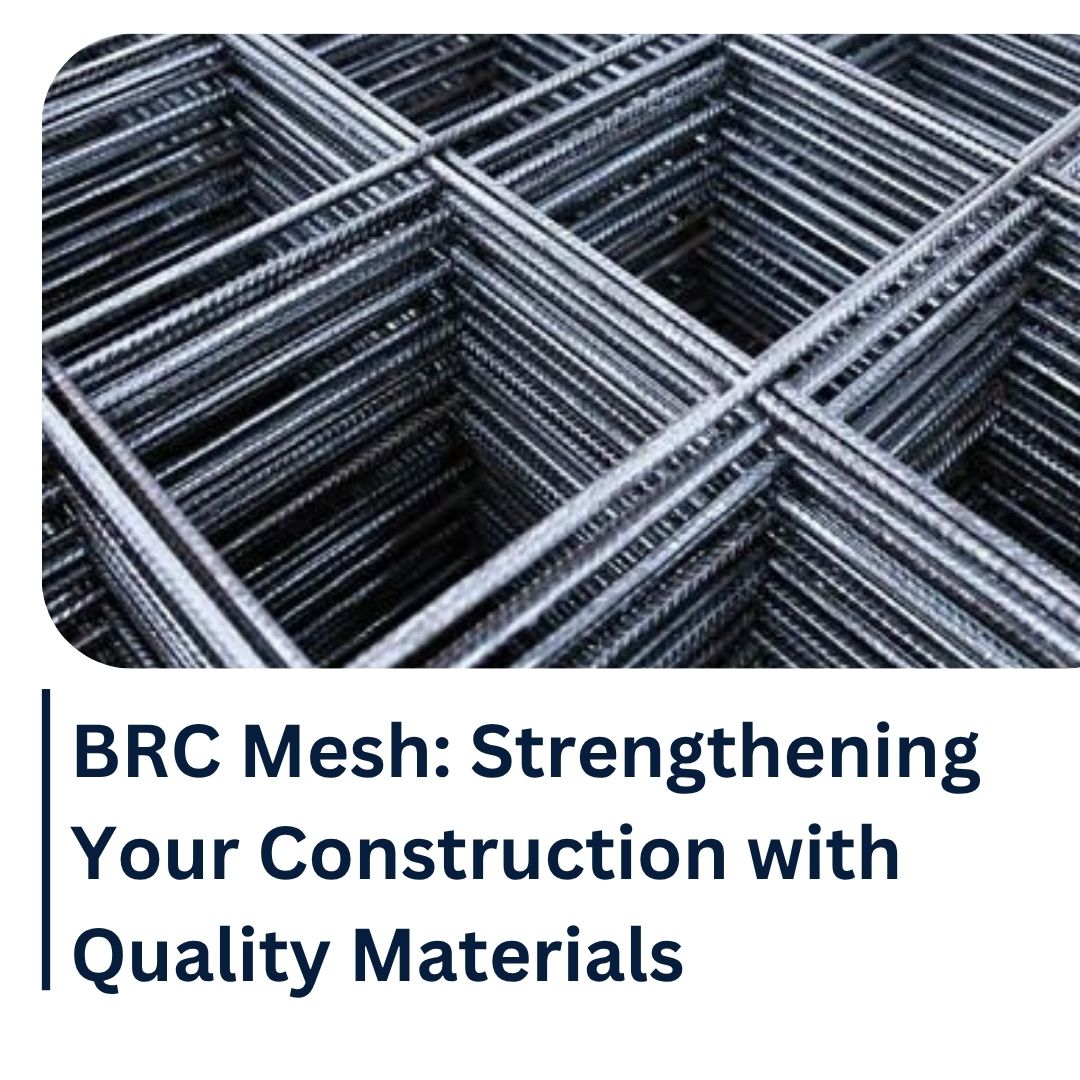
BRC mesh — the name derives from the British Reinforced Concrete Engineering Company, which pioneered factory-welded reinforcement in the early twentieth century — is today a generic industry term for welded wire mesh Oman engineers specify on the majority of reinforced concrete projects. The product is a grid of steel wires joined at every intersection by electric resistance welding.
Unlike traditional bar reinforcement, which is cut and tied on site, welded wire mesh arrives as prefabricated panels. This eliminates a significant proportion of on-site labour, reduces the risk of incorrect bar spacing, and produces a far more dimensionally consistent product.
Understanding the manufacturing process matters because it directly affects the mechanical properties of the finished product.
The process begins with hot-rolled wire rod, typically Grade 500 MPa deformed or plain wire. The rod is drawn through a series of dies at ambient temperature, which reduces its diameter and simultaneously increases its tensile strength through work hardening. The resulting wire is uniform in diameter and has consistent mechanical properties along its full length.
Longitudinal wires (called “main wires”) and transverse wires (“cross wires”) are fed into an automated welding machine. At each intersection, electrodes apply pressure while a high current passes through the contact point. The resistance of the contact generates localised heat, fusing the two wires together without adding external filler material. The integrity of these welds is critical — weld shear strength is a defined performance requirement in all major standards.
BS 4483 is the most widely referenced standard for BRC mesh in Oman and across the GCC. The most commonly specified types on Omani projects are:
Standard panel dimensions under BS 4483 are 4.8 m × 2.4 m (11.52 m² per panel).
Projects with US specification input sometimes call for ASTM-compliant mesh. ASTM A1064 covers carbon-steel wire and welded wire reinforcement.
This is the primary application. Welded wire mesh is placed in the tension zone of concrete slabs. It controls crack width due to shrinkage and thermal movement, distributes point loads, and provides the primary bending reinforcement in lightly loaded slabs.
Continuously reinforced concrete pavements (CRCP) and jointed reinforced concrete pavements (JRCP) use steel fabric to control crack spacing. On Omani highway projects, B-series fabrics are common due to their closer longitudinal wire spacing.
Both cast-in-place and precast retaining wall panels use welded mesh as the primary reinforcement cage. The two-dimensional grid simplifies placing and ensures correct steel positioning prior to casting.
Panels, cladding units, tunnel linings, and drainage channel covers all make use of fabric reinforcement. The dimensional precision of welded mesh is an advantage when concrete cover tolerances are tight.
Heavily galvanised or PVC-coated welded mesh panels are used in erosion control and slope stabilisation — particularly relevant in Oman’s Al Hajar range and along wadi embankments.
Oman’s coastal areas experience high humidity, salt-laden air, and ambient temperatures that regularly exceed 45°C. Always request mill test certificates (MTCs) from your supplier and verify that the characteristic yield strength meets the specified grade before accepting delivery.
For exposed or partially buried applications — retaining walls, slabs adjacent to the sea, and infrastructure along the Musandam or Al Batinah coast — specify epoxy-coated, hot-dip galvanised, or stainless steel mesh where the design demands it.
The structural engineer’s drawings will specify either a fabric type (e.g. A393) or a required steel area per metre width. If the drawings call for a specific BS 4483 type, source that type exactly.
The clear aperture between wires must be at least 1.5 times the maximum aggregate size to allow concrete to flow through the mesh without bridging.
Concrete cover to the outermost wire must meet the minimum specified for the exposure class. In XS (marine) or XD environments, minimum cover can be 40–50 mm or more.
Mesh panels must be lapped a minimum distance at joints — typically 200–300 mm depending on wire diameter. Factor lap lengths and edge trimming into your quantity take-off.
Standard panels (4.8 m × 2.4 m) work well for large open slabs. For narrow strips or irregular shapes, custom-cut sheets can be ordered but carry a longer lead time.
As a trusted BRC mesh supplier Oman contractors have worked with for years, Al Yusr International stocks a range of welded wire mesh products alongside broader steel and building materials — including concrete blocks, structural timber, and rebar cut & bend. With eight branch locations — from Muscat to Salalah and across the interior governorates — the company is positioned to reduce lead times and transport costs regardless of where your project is located.
For availability, pricing, and technical support, visit our Trading and Services page or contact your nearest Al Yusr branch directly.