0
An empty cart
You have no item in your shopping cart

Whether you are preparing a bill of quantities, reviewing a structural specification, or sourcing materials for a new project, understanding the full range of concrete blocks available in Oman is essential. Concrete blocks — often called CMU (Concrete Masonry Units) — are among the most widely used building materials across Oman’s residential, commercial, and infrastructure sectors. This guide covers the main types, standard dimensions, applicable standards, and the criteria that matter most when specifying or procuring concrete blocks Oman projects depend on.
Concrete masonry units are precast blocks manufactured from Portland cement, aggregate, and water, cured under controlled conditions. In Oman’s construction environment, CMU blocks are favoured for high compressive strength relative to cost, thermal mass that moderates indoor temperature fluctuations, compatibility with reinforced masonry and plastering systems, wide availability from concrete block suppliers across all eight governorates, and compliance with the Oman Building Code (OBC), BS 6073, and ASTM C90.
Solid blocks have a net volume of concrete of at least 75 percent of the gross cross-sectional area. They are used in below-grade retaining and boundary walls, heavily loaded load-bearing walls where hollow cores would reduce net section, and piers and columns in masonry construction.
Load-bearing hollow blocks are manufactured to achieve a minimum average net compressive strength of 13.1 MPa per ASTM C90 Grade N. Their cores allow vertical reinforcement and grout fill — a common requirement in Oman for buildings above two storeys and in seismic design zones.
Non-load-bearing hollow blocks are used for internal partition walls and infill panels in framed structures, with a minimum of 3.5 MPa average net area compressive strength. The core geometry also reduces dead load and provides channels for concealed MEP services.
Oman’s climate — with summer ambient temperatures routinely exceeding 40°C — creates demand for wall systems that limit heat gain. Thermal blocks achieve lower thermal conductivity through lightweight aggregate (pumice, expanded clay), multi-cell core arrangements that interrupt thermal bridging, or expanded polystyrene inserts. Always request the manufacturer’s declared thermal conductivity (λ value) and verify it against the required wall U-value.
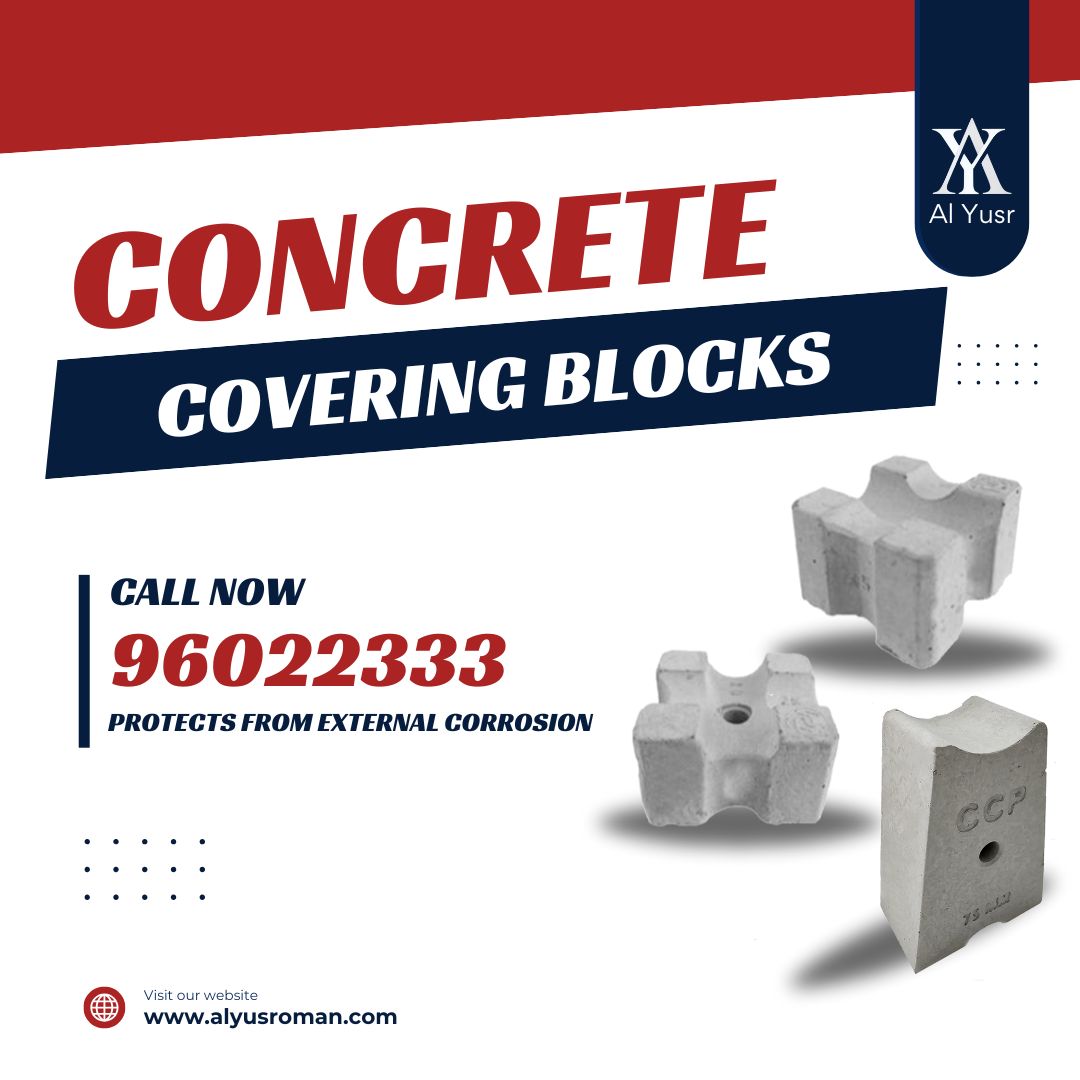
Concrete covering blocks — also referred to as concrete spacers or rebar chairs — are small precast units placed between formwork and the reinforcement cage to maintain specified concrete cover. In Oman’s coastal and high-humidity inland environments, inadequate concrete cover is one of the primary causes of premature reinforcement corrosion. The Oman Building Code and BS 8500 specify minimum cover values of typically 40–50 mm for RC elements in Exposure Class XS2 or XS3.
Key attributes to specify: cover dimension (40 mm, 50 mm, or 75 mm as per structural drawings), compressive strength not less than the surrounding concrete, low water absorption, and a tie wire slot or clip mechanism to hold position during vibration.
| Block Type | Nominal Size H × W × L (mm) | Typical Application |
|---|---|---|
| Standard hollow — load-bearing | 200 × 200 × 400 | Structural walls, external walls |
| Medium hollow — load-bearing | 200 × 150 × 400 | Internal load-bearing partitions |
| Thin partition block | 200 × 100 × 400 | Non-load-bearing partitions |
| Solid block | 200 × 200 × 400 | Retaining walls, below DPC, piers |
| Thermal / lightweight block | 200 × 200 × 400 | External walls with low U-value requirement |
| Concrete covering block | 40 / 50 / 75 mm height | Rebar cover in RC slabs, beams, columns |
The 200 × 200 × 400 mm format is the de facto standard in Oman. Always confirm with your concrete block supplier whether dimensions quoted are nominal or actual — confusion between the two is a common source of setting-out errors on site.
Use load-bearing hollow blocks when the wall is required to carry floor or roof loads and the design calls for grout-filled reinforced cores. This covers the majority of structural walling on Omani residential and commercial projects.
Use non-load-bearing hollow blocks when the element is a partition within a reinforced concrete frame that carries only its own weight. This covers most internal walling on framed buildings in Oman.
Use solid blocks when the application involves sustained moisture exposure — below DPC level, retaining walls, boundary walls — where core voids could trap water and accelerate deterioration, or where net section must be maximised under concentrated loads.
Thermal considerations: A 200 mm hollow block wall with internal plaster and external render achieves a U-value of 1.2–1.8 W/m²K. Adding an insulated render system or cavity moves the assembly toward 0.5–0.8 W/m²K that modern energy performance specifications increasingly require.
For load-bearing CMU blocks specified to ASTM C90, the minimum average net area compressive strength is 13.1 MPa for Grade N units; the minimum individual unit value is 11.0 MPa. Request manufacturer test certificates and arrange independent third-party testing from an accredited laboratory on large contracts.
High water absorption indicates a porous microstructure that allows moisture ingress, carbonation, and accelerated reinforcement corrosion. ASTM C90 limits maximum water absorption to 208 kg/m³ for lightweight units and 176 kg/m³ for medium-weight units. For Oman’s coastal and humid environments, specify the lower end of the permissible range.
Check a sample from each delivery against the specified actual dimensions. The acceptable tolerance under BS 6073-1 is ±3 mm for each dimension. Blocks outside tolerance create inconsistent mortar joint widths that affect structural performance and fair-face finishes.
Reject blocks showing cracking, spalling, surface honeycombing, or excessive efflorescence — indicators of undercompaction, premature demoulding, or inadequate curing, all of which compromise long-term strength and durability.
Al Yusr International supplies concrete covering blocks, BRC welded wire mesh, and a broad range of construction materials to projects across Oman. With trading and services operations serving contractors, developers, and government authorities from eight locations across the country, Al Yusr International supports procurement from early tendering through to on-site delivery. The primary technical references are ASTM C90, BS 6073-1, and the Oman Building Code.
For technical data sheets and procurement enquiries, visit the Al Yusr International trading and services page or contact the branch nearest to your project site.
[…] to construction projects across Oman, stocking film-faced panels in standard thicknesses alongside concrete blocks, BRC mesh, and the full range of structural building […]